Saturday, March 21, 2015

Canadian Wheat - Commodity Branding


More to grain marketing than price


http://www.country-guide.ca/2015/03/04/more-to-grain-marketing-than-price/45986/

Monday, March 16, 2015

New marketing e-book

I'm beginning the research phase of my next e-book. What #marketing topic would you like me to cover?

Friday, February 06, 2015

Suckiest Brand of the Year Award

Please nominate your least favorite for my award. Winner announced in December.

Wednesday, December 17, 2014

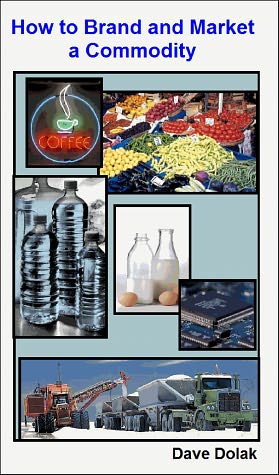
How To Brand And Market A Commodity

Currently on Countdown Deal at Amazon for $0.99. http://amzn.to/1zydt33

Layoffs hit USA Today

My inside source reports that on Dec.10, 2014, USA Today laid off "about 70 staff people, including many of the most experienced...without any notice."

This move reveals the death of print media is coming and that true journalism is near death as bloggers with no journalistic standards or ethics take over in a world of garnering clicks and page views at all costs, regardless of truth or actual vetting.

I wish those USA Today folks all the best.  Please feel free to comment if you are one of those people or some media outlet who wishes to reach out to them.

Tuesday, July 01, 2014

Suggested Reading List: Books on Marketing & Branding

Building the Brand Driven Business, Scott Davis & Michael Dunn
22 ImmutableLaws of Branding, Al Ries & Laura Ries
A New BrandWorld, Scott Bedbury
Leveraging the Corporate Brand, James Gregory & Jack Wiechmann
Selling the Invisible, Harry Beckwitht
Brand Aid, Brad VanAuken
Building the Brand-Driven Business, Scott Davis & Michael Dunn
Emotional Branding, Marc Gobé
BuildingStrong Brands, David Aaker
Why Johnny Can't Brand, Bill Schley 

Death of a Brand: Burn out or fade away?

Good brands are living entities.  They change and evolve with changing market conditions so that they grow and continue to deliver value to both their owners and the consumers they serve.

If a brand is fundamentally an identifiable entity that makes some specific promise of value, then the promises made by healthy brands will continually communicate and deliver significant and relevant value to consumers.

All brands must be managed, not just healthy ones

Much of today’s contemporary information on branding focuses on creating new brands.  The plethora of self-proclaimed branding experts like to tell us their views on the best ways to establish a brand, how to create awareness, how to help brands connect with consumers, how to position brands and how to create brand strategy so brands enjoy strong positions in their markets.

Often these experts fail to acknowledge that not all brands are strong or healthy.

Not all brands are able to successfully adjust to changing market conditions and remain relevant.  Not all brands can continue to promise significant value and actually deliver that value.  Not all brands continue to resonate and remain relevant in an ever-changing society.

The truth of the matter is, according to research conducted by Nirmalya Kumar, professor of marketing at IMD, Lausanne, Switzerland, most brands do not make money for their companies.  Kumar found that year after year companies make most of their money on very few brands.  Significantly less than 20% of the brands in the world deliver the majority of sales and profits.

The logical issue that arises then is not how to create and maintain a new brand, but how to navigate the much more likely -- and much less enjoyable -- decline or death of an existing brand.  How do we know when to put a brand on life support in order to nurse it back to health or allowed it to fade away or actively kill it?

The best way to understand how and when to retire or kill a brand is to understand what a valuable brand should look like and then explore the warning signs that indicate when your brand is in trouble. 

What strong brands look like

Strong, valuable brands promise value that cannot be found anywhere else.  These brands are highly differentiated from competing brands, deliver higher profits than competing brands, and create an aura of superiority that surrounds the brand name, symbol or mark.  Valuable, powerhouse brands also enjoy strategic awareness in the market such that not only do people understand how and why they are different, but those same people understand that those differences make the brand superior and a wiser choice than other offerings.   Powerful and valuable brands influence buying decisions, shape the ownership experience, command a premium price, deliver healthy profits and create trust and emotional attachments with consumers.

As I outlined in my Top EndAlignment™ branding process back in 2003 when I was still consulting, the best brands also tap the guiding vision of the organization and foster the mission of the organization in some way.  These aligned brands not only communicate the unique selling proposition of the brand but also foster the guiding principles of the company or organization.

Such brand leadership must be driven by a strong organizational leader who recognizes the importance of living the brand and ensuring that all levels of his or her organization act in accordance with brand promises.  These visionary leaders also understand that a brand is ultimately controlled by and shaped by consumers and that brands are not just defined by a few people within the marketing department but by the entire organization and its alliance with consumers.

Now that we know what strong and powerful brands should look like, it is important to understand how to recognize when a brand starts to falter.

Monitor your brand’s pulse

Whether you own a single brand or manage a multi-brand portfolio, conducting periodic brand audits is critical to understanding the health of your brand or brands.

A brand audit is a comprehensive examination of a brand that assesses the health of the brand while uncovering its sources of equity.  Through brand audits, you will construct snapshots of the overall health of your brand at any given time while uncovering possible new sources of equity upon which to build.

Consumers’ perceptions about your brand will change over time and you must periodically explore those perceptions through routine audits so you can understand what needs to be done to help your brand evolve and remain relevant while continuing to promise and deliver compelling value.

The warning signs of a faltering brand

The brand audit will result in tangible data to help you assess the health of your brands.  Sometimes your audits will uncover an unhealthy brand.

Some warning signs of an unhealthy brand are:

  • Your brand’s sources of equity have vanished
  • Through the course of natural evolution and growth of your organization, certain brands in your portfolio no longer foster the organizational mission or fit in with overall business strategy
  • The investments you make in your brand cannot be justified based upon the level of revenue and profit those brands return to your organization
  • Nobody within your organization can seem to succinctly articulate your brand’s core values or concisely state its unique selling proposition
  • Your brand is promising more than your organization can deliver
  • Your brand has gotten a bad reputation and new, unwanted associations have been made by consumers
  • Your brand’s identity seems dated or old-fashioned
  • Competing brands now hold the leadership positions in the category
  • Your brand is not reaching out to new, younger consumers and your brand is aging right along with your customers
  • The promises of value your brand makes no longer resonate or remain relevant
  • Your market has moved beyond your brand
  • You do not understand who your brand’s most valuable customers are or why they choose your brand
  • Sales are slumping and so are profits

When you recognize these warning signs you must then analyze if you can and should invest in reinvigorating your brand so that it returns healthy revenue and profit once again, if you should let it fade away, or if you should actively kill it.

When to kill a brand

Building and maintaining brands requires significant investment of effort, time and money.  Sometimes the diminishing returns from the brand no longer make sense to fully support.

If it has been decided that supporting a brand no longer makes sense for your organization then there are several options available to effectively retire or kill the brand.

The brand life cycle

The life of a brand mirrors the product life cycle from introduction to growth, maturity, decline and withdrawal.  While the maturity and decline stages can be significantly extended through innovation, proper brand management and rebranding efforts, ultimately the brand will enter into decline and a decision might be made to retire or kill the brand rather than invest in it.

How to kill a brand

There are four main approaches to killing a brand.

1)       Merge it

In this approach, managers find a closely-related, healthy brand that can be merged with the unhealthy one.  While the unhealthy brand is being dropped, the healthy, surviving brand is simultaneously reengineering to add the old brand’s desirable product features, sources of equity and promises of value that had previously been embraced by the retiring brand’s consumers.  The surviving brand can then boast of new attributes while providing a safe, comfortable place for consumers to migrate.  This approach is often implemented when the retiring brand still has a significant number of customers or when the market has future growth potential.

2)       Milk the cash cow

Cash cow brands return a superior profit to the organization.  Often during the maturity stage, profit numbers slowly start to decline but can often be boosted to desirable levels by slowly withdrawing investment in the brand and reducing the expenses associated with supporting it.  Marketing and advertising activities can be scaled back, brand extensions can be eliminated to reduce management costs, distribution can be changed to cut costs, and all but the bare minimum investment in the brand eliminated.  The company then tries to maximize profits for as long as possible until sales drop to the point where there brand is sold or killed.

3)       Sell it

Sometimes the market value of a brand is greater than the value the brand represents to its own organization.  When this happens, wise brand managers consider selling the brand to an organization who can fully capitalize on the equity of the brand.  If the brand seller is retreating from the category altogether, then selling the brand is much easier than if the company wishes to remain in the category with other brands.  In the latter case, legal safeguards should be put in place so you do not end up with your old brand as a new competitor that damages your remaining brands.

4)       Kill it now

The way you kill or retire a brand might be just as important as creating and building it in the first place.  You may simply drop the brand by eliminating it.  Remain fully aware, however, of the state of ownership of brand names in order to protect yourself from allowing a competitor to buy and resurrect the brand.  Some brands that are killed still have enough equity to be highly lucrative to other organizations.  You must protect yourself from your own brands coming back to haunt you.

Managing brands involves more than just creating and launching them.  Brands in their declining stages must also be properly managed to respect the dignity of both the brand and its consumers.  Only through analysis can you determine whether or not it is better to help a brand return to full health or simply let it die or fade away.

Copyright 2014.  All rights reserved.

# # #

Monday, June 16, 2014

It just keeps getting worse and worse for GM

General Motors today said it is recalling 3.4 million cars in North America because bumpy terrain or weight attached to the key could move the ignition switch out of the run position -- the same basic problem that began its recall crisis earlier this year.


via AdAge.

Sunday, June 15, 2014

Monday, March 03, 2014

Is social media really antisocial?

I'm struck by the new media landscape and how social media shapes just about everything we take in as news and also our interactions with one another.

But this new social media landscape has a dark side.

One needs only to start reading the comments for just about any news story or article and they will quickly see (usually within 3 comments) how people resort to name calling, demagoguery, or just plain rudeness.  Read the comments on just about any YouTube video and you will quickly see the dark side of human nature emerge, complete with cursing, name calling, and incivility.  Most of these people who never speak or behave in such a manner in the virtual world if they were speaking to the person face-to-face or across the table from them.  Why, then, does the illusion of anonymity bring out the worst in human behavior online?

Does social media actually elicit antisocial behavior?

Thursday, December 26, 2013

The Definitive Guide to Marketing Metrics and Marketing Analytics


The Definitive Guide to Marketing Metrics and Marketing Analytics shows
marketing professionals how to talk the talk of C-level executives in terms
of forecasting and reporting, and walk the walk to the revenue table by
leveraging metrics that matter

With compelling graphics and real examples of Marketo’s own metrics and
tactics, this guide offers best practices for harnessing data to not only
prove, but improve ROI.

** *This Paper Explores* **

· The right metrics for understanding and interpreting marketing results

· Revenue metrics that get the executives' attention and prove marketing
ROI

· The critical elements of a marketing dashboard

· And much more

The Definitive Guide to Marketing Metrics and Marketing Analytics

Sunday, August 11, 2013

Branding doesn't happen in your marketing department

Branding doesn't happen in your marketing department. Branding happens when your whole company aligns behind a single idea.

Sunday, July 28, 2013

Most people don't understand branding

Branding isn't something that happens in your marketing department.   Branding is what happens when your whole company aligns behind a single idea.

Wednesday, June 12, 2013

The American Branding advantage?

Branding is inherently a long-term, relationship-building strategy. Do you think American companies are better at branding than Chinese companies because American companies are more relationship oriented while Chinese companies are more transaction oriented?
From the NY Times:
OP-ED COLUMNIST The Romantic Advantage
By DAVID BROOKS


http://www.nytimes.com/2013/05/31/opinion/brooks-the-romantic-advantage.html?smid=pl-share

Friday, May 31, 2013

Oh, the times they are a changing...

This is either one of the dumbest product ideas ever or a brilliant, tongue-in-cheek way for Burger King to generate some buzz.

Monday, April 22, 2013

Allegra anti-itch cream?

When you think "Allegra," do you think of something that is spread on your skin to stop the itchies or do you think of a tablet you swallow to ease nasal allergies?

I know Benadryl extended into the anti-itch cream segment, but I think Allegra is so strong in and closely identified with the nasal allergy segment that trying to be an allergy pill and a skin cream at the same time is just a little too much.  I wouldn't be surprised at all if the cream hurts their allergy med sales.

Just my two cents from the sidelines.

Tuesday, March 19, 2013

My book review: Brand Real

This book is a comprehensive discussion of modern branding and covers the many interrelated aspects of developing and building a brand. Not only must you figure out what your unique promise of value should be (i.e your brand promise or position), but you then must align your entire organization to delivering that value and keeping your brand promise at all customer touch points. This excellent book will walk you through all practical implications throughout the process and help you build meaningful brands along with a brand-aligned organization.

A must read for anyone serious about learning more on the topic of branding.

Thursday, February 21, 2013

One of the best compliments ever

Just the other day I received what I consider one of the greatest compliments ever.  A person whom I consider a mentor told somebody else (referring to me), "He took everything I ever taught him and improved upon it."  :-)

Thursday, November 29, 2012

Marketing & Branding ebooks

My e-books are now available for both Nook and Kindle.

How To Build and Manage Your Brand


For Nook

For Kindle


How to Brand and Market A Commodity


For Nook

For Kindle

Sunday, November 25, 2012

Book review: The Book of Business Awesome/UnAwesome


This is an interesting book. Read either the `awesome' half or the `unawesome' side first and then flip the book upside down to read the other half. One half contains stories about brands getting social media right and the other half contains stories about brands really screwing up in their social media communication practices.

Each chapter is very short and reads as a mini-case study. All are anecdotal based on experiences of the author.

As a result, you will get an easy-to-read book that entertainingly covers best and worst practices in using social media as a business marketing tool.

In my mind the most important aspect of the book is the fact that the author reminds the reader that social media are just tools to communicate with audiences. These channels merely and only enable you to communicate with people. Social media channels can only highlight the corporate behavior in which you are already engaged. If you have lousy customer service then social media will just make it more obvious. If you ask for feedback from customers and state that you want to hear from them but then ignore or delete their feedback, it will reflect poorly on you and expose you as being disingenuous or thin-skinned.

The author is really talking about making sure your organization is aligned properly to treat customers the right way. He then shows how some companies are using social media to assist in those efforts. Some get it right, some get it wrong. Some misunderstand how social media works, others understand it and leverage its powers properly, and yet others simply behave terribly in the first place and social media can't fix those fundamental organizational problems. The social media tools, in-and-of themselves, will not change organizational behavior. My favorite sentence in the book is on p. 83 where the author states, "Social media does not make a company good or bad; it just amplifies what they already are."

Often the entire impression people have about your brand is a result of the one or two people who are responsible for posting your public social media messages so the book serves as a warning to make sure you think that through and create social media strategy and guidelines first before you just cut a couple people loose on your social media initiative. After all, those people can ultimately shape the entire impression people have of your brand.

Friday, October 26, 2012

Deliver to go undelivered?


So, when I open up my October issue of Deliver Magazine, the magazine by the United States Postal Service for marketers aimed at boosting direct mail marketing, should I conclude anything from the editor's letter?  You know, the one in which he states that "the time has come for us to take a little break" and "Deliver magazine is going on hiatus?"

Naw.  I'm sure everything at the USPS is just peachy and direct mail is stronger than ever.

It does seem a bit odd, though, that a magazine that aims to boost direct mail marketing would state that while it is ceasing its printed and mailed version that "you'll still be able to find Deliver content online and download back issues."

Move along folks.  Nothing to see here.  Everything is just fine at the U.S. Postal Service.

Friday, October 19, 2012

Dear Volt, Where do I put the batteries?

I'd say that LG Chem has more than a marketing problem.  Those God-awful consumers just don't seem to want to buy enough Chevy Volts to meet sales projections.

Thursday, October 11, 2012

Funny thing about politics...

This U.S. election year is interesting.  With Facebook and Twitter being so pervasive,  everyone seems to be speaking their mind on politics in real time.  News flash to those trying to sell me things: I will now go out of my way to make sure I never, ever let my dollars flow toward your products and services.  Did you really mean to cut your audience in half?  See also:

Politicizing your brand? Think twice, please.

Thursday, September 13, 2012

Good brand behavior found!

Here is a brand that gets it:

"We owe you a big apology for the intermittent service outages we experienced on September 10 that may have impacted your website, your email and other Go Daddy services.

We let you down and we know it. We take our responsibilities — and the trust you place in us — very seriously. I cannot express how sorry I am to those of you who were inconvenienced.

The service outage was due to a series of internal network events that corrupted router data tables. Once the issues were identified, we took corrective actions to restore services for our customers and GoDaddy.com. We have implemented a series of immediate measures to fix the problem.

At no time was any sensitive customer information, including credit card data, passwords or names and addresses, compromised.

Throughout our history, we have provided 99.999% uptime in our DNS infrastructure. This is the level of performance we expect from ourselves. Monday, we fell short of these expectations. We have learned from this event and will use it to drive improvement in our services.

As a result of this disruption, your account will be credited for the value of 1-month of service for each of your active/published sites.* This credit will be available to you for the next 7 days. Please click the button below to redeem your credit.


It's an honor to serve you. Thank you for the opportunity to re-earn your business and trust.

As always, please call us 24/7 at 1-480-505-8877 — anytime, for any reason.

Sincerely,

Scott Wagner
CEO
GoDaddy.com"

Tuesday, July 17, 2012

Is the Chevy Volt really a car that nobody wants to buy?

THE MADNESS OF THE VOLT:

...." a textbook example of seizing a staggering amount of money from taxpayers, and plowing those resources into an utterly failed attempt to create a “market” for something nobody wants to buy."

The downward spiral of a brand


When you hear gobbledygook like, "[Dell] has transitioned to an 'end-to-end' business IT company in the past five years," you just know a brand is bleeding the equity it once had.We are not just a PC company

Wednesday, July 04, 2012

U.S. Independence Day

"Those who expect to reap the blessings of freedom, must, like men, undergo the fatigue of supporting it." ~Thomas Paine


"Where liberty dwells, there is my country."  ~Benjamin Franklin


"Four score and seven years ago our fathers brought forth on this continent a new nation, conceived in liberty, and dedicated to the proposition that all men are created equal." ~Abraham Lincoln, The Gettysburg Address, 1863.


"There, I guess King George will be able to read that." ~John Hancock, on signing the American Declaration of Independence.


Sunday, June 24, 2012

Corporate Social Responsibility

Corporate Social Responsibility, or CSR, is not new.  These company behaviors date back to early Capitalism and the two are not mutually exclusive, despite popular political opinion.

http://blogs.hbr.org/video/2012/06/a-brief-history-of-doing-well.html?awid=4929111144116256515-3271

Tuesday, June 05, 2012

Is the thrill of Facebook starting to fade?

 In a Reuters story today, a recent survey revealed that 4 out of 5 Facebook users have never bought a product or service as a result of an ad or comment viewed on Facebook.  Even more discouraging is the fact that while the number of Facebook subscribers might be growing, 34% of those surveyed reported that they are spending less time on the site than they did 6 months ago.

Advertising on the site appears to not be very effective and user engagement is waning.

These are very hard facts and a tough position to be in for a company with an advertising revenue business model.

Tuesday, May 22, 2012

Facebook stock is down? How predictable.


So after the third day of trading, Facebook is trading for $31/share after an IPO last Friday at $38/share.

If I've got this right, we're talking about social networking company that gets the majority of its revenue from advertisers, that has users who hate ads, and the ad model doesn't really work well on mobile devices anyway...which just happens to be an ever-increasing percentage Facebook total users.

News flash: User growth does not equate to profit growth. I thought we learned this during the dot com bubble of the 1990's.

Just because a social networking site can attract a lot of non-paying users does not mean it creates significant value for anyone. Value exists when people are willing to pay something to get it. How many people would stay on Facebook if they were charged a monthly fee to do so? How many users are willing to click on ads and purchase products so value is created for advertisers?

Until Facebook can figure out a way to create sustainable value for its users and/or advertisers such that people are willing to start engaging in commerce on Facebook in significant ways then it has a faulty business model. Attracting lots of eyeballs never was a business model in and of itself. Money needs to start changing hands.

SEE ALSO: Social media is not a business model.

Wednesday, May 02, 2012

Last issue of Personal Branding Magazine

Personal Branding Magazine publishes its last issue.

Publisher Dan Schawbel provides no explanation for why the magazine is ceasing publication, but offers it for free.


Tuesday, April 24, 2012

You don't ultimately define your brand.

You don't ultimately define your brand. Your brand is defined by the people in your market. Branding is about authenticity and respecting your customers so they gladly allow you to have some influence on shaping how they view your brand because they trust you and got more value from you than the investment they made in your brand.

Thursday, March 22, 2012

Image, Response, and Eye Candy: Trade show giveaway strategies

A colleague once asked me if I would suggest or recommend a giveaway or promotional item for his company. His company exhibited at many trade shows throughout the course of the year and he felt a giveaway item, or "tchotchke", would help his booth personnel draw traffic to his company's exhibit booth.

Despite the fact that the age of trade shows seems to be quickly fading, this topic is still often discussed amongst marketers and the thought of giving away a promotional item with a corporate logo or URL in mass quantities is very tempting to many trade show marketers. "What could be better?", they think, than placing the company name or logo in front of many, many people?

I thought I'd share some of my thoughts about promotional items with you that you might find helpful if you are considering incorporating promotional, giveaway items as a part of your trade show marketing efforts. Examine my colleague's logic and see if it sounds familiar to you...

COLLEAGUE'S PERCEPTION:

"I think at shows we need to have freebies or a giveaway item to just get our name out there and get more people stopping by the booth. This may not increase the quality of leads, but it does increase traffic for traffic's sake".

MY THOUGHTS:

Giving away freebies to increase booth traffic just for traffic's sake is foolhardy unless you can give away an item that makes a lasting impression at very low expense. This represents a very big challenge and it might even be an oxymoron. Untargeted promotion is simply a waste of money.

The best "freebies" are those that are targeted toward the right audience, that clearly communicate benefits, and that are just one part in a methodical, brand-building campaign that is reinforced by other marketing communications. Too many companies spend far too much money on expensive giveaway items that have little to no impact. Worse yet, these companies often do not even understand the impact or effectiveness of their giveaway item because they can not or do not measure the campaign in any way.

If you are thinking about using a giveaway item as a trade show marketing tactic, the place to start is with careful consideration of your budget and your goals. Believe it or not, I've seen more than a few trade show giveaway campaigns launched because the boss wanted a golf shirt with the corporate logo on it or because he/she thought all the employees of the company would appreciate a new T-shirt. This should not be the reason you launch such an initiative. Some things that should help define your campaign are:

- Your budget
- Your goal
- The message your giveaway item will communicate
- Your target audience
- The impression you are trying to create

You must ask yourself how much money you can afford to spend and how many impressions you need to make with that budget to achieve your goals. As with any other form of marketing, if you can't measure it then you shouldn't be doing it.

You, wise marketer, know you must work hard to fully understand the economics of the campaign, measure it, and maximize the effectiveness of each and every dollar you invest. You also need to define what you hope to accomplish with your campaign. Will you use the giveaway item to generate tangible sales leads? Will you use the item to reinforce your brand or identity in a complementary fashion to your other marketing communications? Will you use the item to reward your existing prospects and engage them in continuing dialogue?

Let's take a look at some of these strategies a little more closely.

Choosing the item

It is best to have a giveaway item that is somehow related to your business or products -- if at all possible. As examples, carpenters could give away rulers, car dealers - key chains, coffee shops - coffee mugs, etc. The more closely related the item is to your business the better because people make associations in their minds so give them a "hook" to make such an association. If you can't find an item that is somehow related to your business or product, at least make sure the creative aspect of the item conveys a close tie to your business or product.

I have seen or have been involved in successful campaigns that have used letter openers, ice scrapers, lotto scratch-off tools, posters, custom printed logo labels on water bottles, calendar magnets, pens, T-shirts, and coffee mugs. Any of these items, if targeted to the wrong market or with the wrong imprinted message, could just as easily have been losing campaigns. The possibilities when it comes to choosing a promotional item are almost limitless so take some time to explore the options available and choose an item that matches your business.

Image campaign

Some businesses have large budgets they can use to create an item that reinforces an ingrained marketing message or to help project corporate identity. These companies may be able to afford anywhere between $ 5.00 to $50 or higher per item and give the item away in an uncontrolled manner to anyone who walks by their exhibit booth and grabs one. They have closely analyzed their costs and know the lifetime value of their customers such that they know this approach is very effective for them. If you fall into this category and you know your costs are worth it to build your brand or identity, then by all means try a creative or clever giveaway item that reinforces your brand or identity and get it into as many hands as possible at your next exhibit. Most businesses, however, do not have such a strong identity or such strong brands that this type of image campaign is cost effective.

Customer relations campaign

You might be able to succeed giving away a high value item in a relationship building capacity if you make sure you target your prospects first and only invite pre-qualified prospects to stop by your exhibit booth and receive the giveaway item. Often you can target your audience by sending out a special invitation to your in-house mailing list or by carefully selecting the right segment of the pre-registered attendees using the exhibit's mailing list. In other words, target people you know have the need for or the interest in your products/services first, invite them to visit you at your exhibit booth, and then use the giveaway item as an additional incentive for them to stop by your booth. Marketing is a relationship and you are rewarding your prospects for staying in the relationship with you in this case.

Drawing or raffle

An alternative to using expensive giveaway items as incentives for pre-qualified prospects is to give away only one (or few) such items via a drawing in which you ask booth visitors to drop their business cards into a bowl and then conduct a drawing at the end of the exhibit. You will undoubtedly suffer from the "unqualified lead" syndrome if you choose to go this route. Some marketers use this tactic when they define a dangerous metric to measure their campaign -- the number of leads garnered at the exhibit. We're after quality of leads not just quantity. Do not fall into the trap of thinking that everyone who attends the exhibit or trade show is a qualified prospect. The number of names collected at an exhibit is rarely an effective measure of success.

Also, not only does the "drawing" campaign have to be fair, but it has to be perceived as fair. If people feel they don't have a chance at winning because the odds of winning are very small, then this will limit the effectiveness of the campaign. If you choose this tactic, you also run the risk of overburdening your sales force with expensive follow-up activities or sending out lots of literature to unqualified prospects. This is a hidden expense that many marketers overlook. Lastly, if you choose to conduct a drawing for your giveaway item, make sure it is not against the policy of the exhibit. Sometimes such games of chance are strict "no no's" and against the rules of the exhibit.

Response generation

Most marketers I talk with are interested in maximizing the lead or response generation aspect of the giveaway item while minimizing expenses.

If you wish to use the item as a lead or response generator, then you should think about how that item will either lead to the capture of a person's contact information for sales follow-up or how you will measure the reach and marketing effectiveness of that item. Do not create an item that provides no way for people to contact you (don't laugh, it happens). You are trying to generate a response so you need to provide a way for people to respond.

Ice breaker

If you think, like my colleague initially thought, that you must give away something in great numbers in order to (try to follow the logic here): Increase booth traffic in the hope of talking to more people in order to try to uncover needs and hopefully make a match between those unmet needs and your products and you don't care to measure response rate, then save your company some money and try using some low cost item such as candy. What you are really looking for is a way to break the ice with people and attract people to your booth regardless of whether or not they might have a need for your products or services. I don't necessarily recommend this tactic for everyone, however, it can be effective for people who feel compelled to give away something to attract booth traffic, qualified or not, on a very tight budget.

A bowl of candy is an excellent, inexpensive tactic that works well in this case. Think about it for a moment. A bowl of candy in your exhibit booth is very low cost, will not take much effort on your part, will be appreciated and most visitors will appreciate a little bit of chocolate, a mint, or other such confectionery delight. People will walk up to your booth and ask if it's OK to take some candy. At that point, it is very easy to say, "Sure, help yourself. By the way, what do you know about how you can benefit from our products"? You have broken the ice, you brought people to your booth, and it did not cost you a great deal of additional money on top of the cost to exhibit at the show in the first place.

Impressions

The risk we as marketers take with any giveaway item is that it will attract unqualified takers that are only interested in getting something for free. Since we can never fully and absolutely control this, another alternate tactic is to give away an item that has high pass along value. In other words, an item likely to be highly visible on a desk, attached to a wall, or otherwise be visible for many other people to see. Impressions is the name of the game in this case and we want to maximize the number of impressions -- or exposures to our advertising message -- while minimizing costs.

Examples in this case might be posters, magnets, or paperweights. Giving away expensive or personal items such as laser flashlights, calculators, hand-held electronic organizers, etc. are generally not a good ideas in this case because, although many people will want them, they will be consumed by individuals and very few other people would ever have the chance to see your company's advertising message.

Think about it for a moment.

Have you ever received a calculator as a giveaway item? Did you leave it out in the open for many other people to see or did you hide it in a drawer somewhere so nobody else would see/take it? If you choose to maximize ad impressions with your giveaway item, carefully consider how the item will be visible to many other people or how high its pass-along rate will be. An item given away to maximize ad exposures should clearly and concisely state a primary benefit of your products or services and also contain contact information, such as a URL, address, or telephone number.

Measurement

Measuring your campaign is critical. Here are just a few ways to measure the success of your giveaway promotion:

- Require booth visitors to swipe their conference badge through your electronic card reader
- Require visitors to fill out a form requesting additional information and indicate their level of interest
- Conduct or commission pre- and post-exhibit market research surveys to measure the effectiveness of your campaign and its impact on strategic awareness
- Train your booth personnel to record as much information about your visitors as possible. Booth personnel should collect business cards or otherwise capture people's names and contact information, as well as, take extensive notes about their personal interactions with booth guests

Creating an effective giveaway item for your trade exhibits can be a very important part of your marketing mix. Now that we've taken a look at some ways to approach the process, I want you to think about what you are trying to accomplish before you launch your next trade show giveaway campaign. Understand your budget, define tangible goals, develop a strong message, establish ways to measure the campaign, and most of all, be creative and have fun!

Good luck and happy exhibiting.

A disembodied voice tells us about branding...


Monday, February 27, 2012

What is a QR Code?

Have you started to see strange, digital squares in restaurants, in stores, and on advertisements lately?  Do they seem strangely familiar yet oddly, well, odd  and out of place to you?

Welcome to the age of QR Codes.

And just what is a QR Code?  "QR" stands for Quick Response and these Quick Response Codes are popping up everywhere because they are essentially bar codes...but of a very special kind.

No longer just about keeping inventory or tracking products on assembly lines, these QR bar codes are a way for marketers to generate a unique code that will allow anyone with the proper bar code reader to scan the code and be taken immediately to a website or URL of their choosing.  Most times this will be a web page with more information about the product, an online video, or some additional information regarding the product or service that the marketer is offering.  By taking you to a URL via the QR Code the marketer is able to provide a much more detailed and often multimedia-enhanced experience that otherwise would be space or cost prohibitive.

And just why are these things cropping up everywhere?

That would be because more and more people are carrying fancy bar code readers in their pockets and purses.  These fancy bar code readers are called smartphones.

So now you know.  When you see these QR Codes they are intended for people with smartphones who will scan these codes with their phones and then be taken immediately to an online web page to learn more about the product or service.

Let's Lift the Human Spirit

Many advertisers and marketers seem to have lowered their standards to the least common denominator when creating and communicating their messages. Far too many in our profession seem to appeal to the dark side of the human psyche.

Many marketers feel that no message or style is too raunchy if it provides shock value in the quest for increased awareness and profits.  Although these tactics might be providing short-term bumps in sales and brand awareness, they might be damaging brand equity in the long-term. Further, the messages sent are often socially irresponsible or have no lasting moral value.

As marketing professionals, we create brands and ad campaigns intended to appeal to emotion and elicit behavioral change. Since we are doing the work anyway, we should appeal to positive emotions and seek to elicit responses that lift the human spirit and, perhaps, maybe even bring out the best in others...


Sunday, December 11, 2011

'Tis the season

While in the store earlier today I happened upon the following board game:


Nothing tells me that the holiday season is being ruined by commercialism more than a board game based on logo recognition!

At first I could not believe that anyone would buy this game let alone create it.  Next I was curious about it.  Now I'm secretly hoping to be able to play it to see how well I do.

Tuesday, November 22, 2011

Where do good ideas come from?

Despite what many believe, good ideas might not come from flashes of insight or moments of brilliance.  Here is a good video that discusses further.

Tuesday, November 08, 2011

One cynic's view: Morality makes terrible brands

A strong brand creates an emotional bond with consumers and establishes a degree of trust.  This bond and established trust attracts brand advocates who allow a brand to make some missteps along the way and these brand advocates are a little more understanding and forgiving when these setbacks occur.

Unfortunately, I fear that our society does not behave the same way toward brands that are connected in any way with a squeaky clean image or those built upon any degree of morality as a driver of brand equity, however much or little that morality is implied or explicitly defined.  It seems to me that brands that are widely perceived as being moral or clean or uplifting become huge targets upon which many people will turn as soon as there is even the slightest hint of misstep, lapse in judgement or setback. Often before the facts are even in.

Perhaps it is the natural tendency for humans, who by definition cannot possibly be 100% moral, to tear down and try to destroy something perceived as morally superior at even the slightest hint of a failing because it makes us somehow feel better about ourselves.  Perhaps we resent any air of morality associated with a brand because we know it is impossible to be 100% moral 100% of the time.  Perhaps brand managers who foster any sense of morality are simply setting their brands up for catastrophic failure when an inevitable lapse occurs.

Why do we allow a lesser degree of forgiveness or understanding for brands that are built upon any degree of moral value?  Why do people seek to completely destroy these brands when an inevitable misstep happens?

It seems to me that we ought to allow these brand more leeway but quite the opposite occurs.

Brand managers beware.

Friday, August 26, 2011

Don't want U.S. jobs to go overseas?

As our U.S. economy continues to struggle it is quite common to hear people on radio and television talking about the state of the economy and the job market.  One comment I tire from is when people state, "I don't want U.S. companies to move our jobs overseas when we need those jobs right here."

Stop to think about that for a moment.

Companies do not  move jobs overseas to be mean-spirited.  They move jobs overseas to find a lower cost structure so they can remain competitive in a world where low price is a main driver of consumer behavior--especially during difficult economic times.

So the next time you find yourself complaining about American jobs going overseas stop and ask yourself if you are willing to buy more American products and pay more for them than foreign comparable ones.  If you would rather continue to choose products with the lowest prices so you can save money then look in the mirror the next time you are looking for reasons jobs are going to other countries with substantially lower labor costs.

Thursday, June 02, 2011

Book review: Enchantment by Guy Kawasaki


In this work Guy Kawasaki manages to take basic truths about business, sprinkle in a little bit of useful information about the latest social media technologies, stretches it all into book length and emerges with a book that will underwhelm anyone who has read other business books related to marketing, branding and/or customer satisfaction.

That is not to say the book does not have an audience.

If you are a young entrepreneur or new to business management then this is a good book that will teach you the basic generalities of how to create useful products that people want and appreciate. You'll gain a better understanding of why it is important to be truthful in your marketing, why it is important to create realistic expectations for customers and why delivering on promises (and making the right promises) will help you build your brand. You'll gain a better idea, conceptually, of how to create products that stand out and are different in a crowded marketplace.

For those who have read other books on business management or basic marketing the triteness of this work will envelop you in a familiar fog of vague, basic truths about how to deal with people in the manner or style of Dale Carnegie, Napoleon Hill and Zig Ziglar. If you are looking for meatier nuggets than "be likeable, "be trustworthy" and "be prepared" then you'll want to pass on this work unless you are seeking a breezy refresher or looking to renew your commitment to The Boy Scout Law.

The later chapters that provide some useful and actionable information on how to most effectively produce online marketing videos and how to leverage push/pull technologies earn it three stars from me, but I was hoping for much deeper insights, more current case studies and more actionable information.

Monday, May 02, 2011

Everything counts in brand building

OK.  So I'm a bit of a brand geek.

I was watching a documentary-style news program about Coca-Cola the other night when a company spokesperson talked about introducing the contoured bottle shape to the company's 2 liter beverage offering in an effort to try to produce incremental sales.  (It is truly an art when a change in packaging produces increased sales with absolutely the same product inside.)

That reminded me of a previous post for which I took some flak regarding the redesign of Wal-Mart's soda packaging.  But that's not what I want to talk about today.

Today I want to talk about pizza.

Last week one of my Facebook friends posted the following picture to his wall (photo used with permission) along with his thoughts, "It seems like there are more toppings in the picture."

As you probably already guessed, the post sparked a number of humorous comments regarding deception, truth in advertising and the importance of good lighting in the studio when taking product shots.

It made me think a little about product packaging and how important package design is to a brand.

In this day and age, why would a product brand use packaging or labeling that misrepresents the product? 

Social media almost ensures that any misrepresentation is going to not only be uncovered but shared with many, many people.  Here is one of my fraternity brothers from yesteryear opening a package of pizza in his home and he feels so fooled by the packaging that he snaps a picture and uploads it to his Facebook page where no less than 136 people ( # of his FB friends at the time) see it, realize the misrepresentation on the package and then start commenting.  Do you think Frescetta has helped or hurt its brand at this point?

When you are managing your brand everything counts.  The product itself, the promises you make and keep, and even the promises made or implied by your packaging.  If your product does not deliver on those promises then you have made a one-time sale and probably hurt your chances for repurchase and long-term brand loyalty.  There simply is no place to use deception or misrepresentation because in this day and age of social media and user-defined brands, you just won't get away with it and you'll achieve the opposite of a strong brand.

Perhaps I've misrepresented this as a blog post about pizza.

Mea culpa!

This post was really about how packaging can either support or undermine your branding effort. Use packaging wisely.